Marsala
The Florios of SicilyMarsala is a Sicilian port town whose place in the Florio story shifts from refuge for an estranged branch of the family to a center of commercial enterprise and a landscape of memory. It shelters Mattia and her son when their circumstances deteriorate, receives letters and financial help sent by Ignazio, and later becomes the setting for Vincenzo’s wine venture and his reflections on a partnership that has broken apart. Through Marsala, family obligation and economic ambition meet: the same town that offers a place to begin again also records what success cannot repair.
Refuge and family ties
Mattia and her children move to Marsala after her husband, Paolo Barbaro, becomes unable to work because of illness. He finds the family an inexpensive house there. Their difficult circumstances make returning to Bagnara seem impossible: Paolo is too proud to face people there while the Florios prosper, and cannot bear the talk that would follow. Marsala is therefore not simply a convenient address but a refuge from the public comparison between the two families’ fortunes.
Ignazio’s connection to Mattia persists across the distance. He sometimes sends money to help with the children’s needs and Raffaele’s studies, while acknowledging that the support may also ease his own guilty conscience. He has agreed to Giuseppina’s requests to write to Mattia, despite Paolo’s order that she break off the relationship. When Ignazio asks a sailor returning from Messina to deliver a letter in Marsala, he specifies that it must reach Mattia alone. The delivery matters precisely because family communication has become private and precarious.
Mattia later travels from Marsala to visit the Florios with Raffaele, with Ignazio paying for their journey. The visit requires a confrontation with her husband, who objects that they cannot afford the trip and that Paolo does not merit such a sacrifice. Mattia nevertheless goes, acting on her belief that the Florios must not abandon their own blood. Her return to Marsala is painful: Ignazio gives her money, and Giuseppina embraces her, but she leaves convinced that she will never see her brother Paolo again. Marsala remains her home, but the visit makes plain how far kinship has fractured.
Commerce, routes, and the town’s wider setting
The novel places Marsala within a wider Sicilian and Mediterranean economy. Spices reach European markets through long chains of transport and many intermediaries, with costs accumulating along the way. In the early nineteenth century, British and French merchants dominate the trade, bringing colonial goods by ship; as prices fall and ports open, Palermo’s spice market expands. The Florios’ own trading network draws on goods from India supplied through British channels and on products from French colonies sold through Livorno and the Tyrrhenian Sea. Their warehouses at Palazzo Steri allow goods to wait in transit before import duties are paid when they enter Palermo. This commercial world offers context for the later ventures associated with Marsala: wealth depends not only on local production, but also on routes, storage, shipping, and access to markets.
Marsala’s economic importance is linked in the narrative with the labor and extraction shaping Sicily more broadly. Sulfur mined by men and children travels from the island to markets across Europe, especially Britain, as well as to northern Italy. The account of these exports sets commercial expansion against the strenuous work that supplies it. In a different branch of the Florio enterprise, tuna from the Arenella fishery appears in a household scene as a preserved product, connecting the family’s business interests with everyday use. Marsala is not described as an isolated backdrop: it belongs to a landscape of ports, commodities, labor, and ventures that cross the island and the sea.
Wine, enterprise, and memory
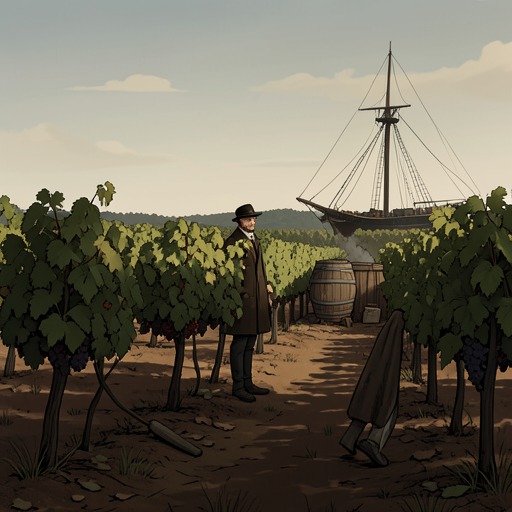
Vincenzo’s first visit to Marsala is remembered as the beginning of a consequential venture. He sees land beside the sea, oversees the first batch of wine, and watches anxiously as a ship carries the first cargo of Marsala to France. The memory joins place, production, and export: the wine’s significance is measured not only by what is made locally, but by the moment it leaves the island for a foreign market.
Fifteen years later, Marsala is again the site of business and family reckoning. In fall 1852, a carriage reaches the Florio courtyard after a journey along the road to the town; Giovanni Portalupi welcomes his brother-in-law. The men first attend to account books, advance payments, and sales orders. Their commercial routine delays the private conversation that follows, making the accounting work part of the scene’s structure: business has to be brought to order before unwelcome news can be addressed.
Alone afterward, Vincenzo remembers the first wine shipment and the early closeness he shared with Raffaele. They had once been able to call each other friends as well as cousins; now Vincenzo does not even know exactly where Raffaele lives. The recollection turns Marsala into a measure of change. The venture began alongside a strong personal bond, but commercial and family history have since carried the cousins apart. Pride, bitterness, solitude, and resentment gather around the contrast between the enterprise’s early promise and the relationship’s present distance.
From Marsala to Favignana
Marsala’s commercial story also opens onto Favignana, where Vincenzo’s investment in tuna processing becomes one of his major achievements. He has managed the Favignana tonnara for ten years by the time he brings his fourteen-year-old son Ignazio there for the first time. The work has demanded high rent, a network of entrepreneurs, and the acceptance of risk in adopting a new preservation method. By then, tuna preserved in oil has spread throughout the Mediterranean.
Vincenzo uses the visit to teach his son to look beyond the immediate request and understand what people actually need or value: whether a remedy answers real pain, whether wine is wanted for quality or prestige, and whether a request for money arises from ambition or financial trouble. Ignazio later walks through the village alone while his father meets Genoese agents. The changes around him are concrete: flagstones now pave the square outside the main church, and his father has arranged a teacher for anyone wishing to learn to read and write. The scene links the family enterprise to an altered local landscape while preserving the distinction between its commercial achievements and the needs of the people who live there.
Place, inheritance, and limits
Marsala gathers several strands of the Florio history without resolving them into a single account of progress. It provides a low-cost home for Mattia’s family, receives Ignazio’s discreet efforts to maintain contact, and becomes the starting point for a wine business whose first cargo sails to France. The town is also where Vincenzo’s memory of early partnership collides with his later isolation. In the wider setting, expansion depends on goods, transport, labor, and commercial networks; within the family, blood ties do not guarantee lasting closeness.
That tension sharpens when the question of inheritance becomes explicit. Giuseppina believes what Ignazio and Vincenzo have built must be safeguarded and passed on, and concludes that Casa Florio needs a suitable heir and a carefully chosen marriage for her son. Years later, Giulia tells Vincenzo that she lived with their children without rights and feared being displaced by a marriage arranged to protect his interests and those of Casa Florio. She insists their daughters must not be made to endure the humiliation she experienced. Read alongside Marsala’s commercial history, the family’s ambition to preserve its legacy appears as both a source of enterprise and a force that imposes costs on those whose place within that legacy remains insecure.